NY, USA
Harlem Heights
The Revolutionary War history of Harlem Heights.
Why Harlem Heights Matters
The Battle for Harlem Heights: Where the Continental Army Found Its Spine
On the morning of September 16, 1776, a ragged line of American soldiers did something they had not done in weeks — they advanced. After a summer of catastrophic defeats, humiliating retreats, and collapsing morale, Continental troops on the rocky, wooded plateau of northern Manhattan turned to face the British army and drove it backward. The engagement that followed, known as the Battle of Harlem Heights, was modest in scale but enormous in psychological consequence. It was the moment when George Washington won his first battlefield victory of the war — the moment when his battered forces proved, to themselves as much as to anyone, that they could stand against professional soldiers in open combat. To understand why that mattered, one must trace the chain of disasters that brought the Continental Army to Harlem Heights in the first place, and follow the events that radiated outward from that ground in the desperate autumn of 1776.
The story begins with New York City itself, which Washington recognized as the strategic prize the British would seek after their evacuation of Boston in March 1776. Whoever controlled the city controlled the Hudson River, and whoever controlled the Hudson could sever New England from the rest of the colonies. Washington moved his army south and spent the spring and summer fortifying Manhattan, Brooklyn, and the surrounding waterways, but the task was nearly impossible. New York was an island city surrounded by navigable waters dominated by the Royal Navy. When General William Howe landed an enormous British force on Staten Island in July — eventually swelling to some 32,000 troops supported by his brother Admiral Richard Howe's fleet — Washington faced an adversary who could strike almost anywhere along miles of vulnerable coastline. Major General Nathanael Greene, one of Washington's most capable subordinates, fell gravely ill with fever in August, removing from the field the officer who best understood the Brooklyn defenses at the worst possible moment. The Battle of Long Island on August 27 was a rout. Howe executed a brilliant flanking maneuver that crushed the American left, killing or capturing over a thousand men. Only a miraculous nighttime evacuation across the East River on August 29 — carried out in fog and silence by Massachusetts fishermen — saved the army from total destruction.
What followed was a crisis not merely of strategy but of spirit. Washington pulled his forces into Manhattan but struggled to decide whether to defend or abandon the city. Several prominent figures, including Greene and New York's John Jay, advocated burning the city to the ground rather than let the British enjoy its benefits, but Washington laid the question before the Continental Congress, which flatly rejected the idea. On September 11, a last-ditch attempt at diplomacy collapsed when Benjamin Franklin, John Adams, and Edward Rutledge met Admiral Lord Richard Howe at Billop Manor on Staten Island for what became known as the Staten Island Peace Conference; negotiations broke down over the British refusal to recognize American independence. His army was melting away through expired enlistments, desertion, and sheer demoralization. By September 12, Washington had convened a council of his generals, and the decision was made to abandon New York City. Four thousand Continentals under General Israel Putnam remained to defend the city and lower Manhattan while the main army moved north to Harlem and King's Bridge.
The British struck before the evacuation was complete. On the morning of September 15, General Howe attacked the vulnerable American center at Kip's Bay, where five British warships sailed into the East River and anchored two hundred yards offshore. The results were devastating. As Howe's troops fanned out, the American center collapsed; Washington, four miles away in Harlem when he heard the firing, rode to the scene and was dismayed by the militia's panicked flight, and even struck some fleeing soldiers with the flat of his sword in a futile effort to halt the stampede.
Putnam and his aide, the young Major Aaron Burr, managed to evacuate approximately 3,500 men from the city northward to Harlem Heights. Washington now held only the northern portion of Manhattan.
He established his headquarters in the Morris-Jumel Mansion, a Georgian country house built in 1765 as a summer retreat for British Colonel Roger Morris and his American wife Mary Philipse — before Harlem Heights developed into the vibrant community it is today, the site commanded sweeping views of lower Manhattan, New Jersey, and Westchester. With the outbreak of war, Morris, a Loyalist, had left for England.
Washington's use of the house as his temporary headquarters between September 14 and October 20, 1776, is well documented by his daily correspondence and official papers. It is Manhattan's oldest surviving residence and still stands today as a museum.
Early in the morning of September 16, Washington began composing a letter to the President of Congress. "We are now encamped with the main body of the army on the Heights of Harlem," he wrote, "where I should hope the enemy would meet with a defeat in case of an attack."
Before he could finish, an alarm went up in the camp. The engagement that unfolded would prove to be that hoped-for defeat of the enemy — modest in its dimensions, but a turning point in morale.
Washington had, weeks earlier, taken a step that would shape the battle's opening moments: on August 12, he had promoted Thomas Knowlton to lieutenant colonel and ordered him to select a group of 130 men and 20 officers from Connecticut, Rhode Island, and Massachusetts regiments to carry out reconnaissance missions in dangerous areas.
This elite detachment, known as Knowlton's Rangers, specialized in espionage and reconnaissance and is considered the origin of America's first professional military intelligence capability. Among their number was Captain Nathan Hale, the American spy , who at the very time of the battle had left behind his uniform and identity to go undercover behind British lines, gathering information and attempting to establish an espionage network.
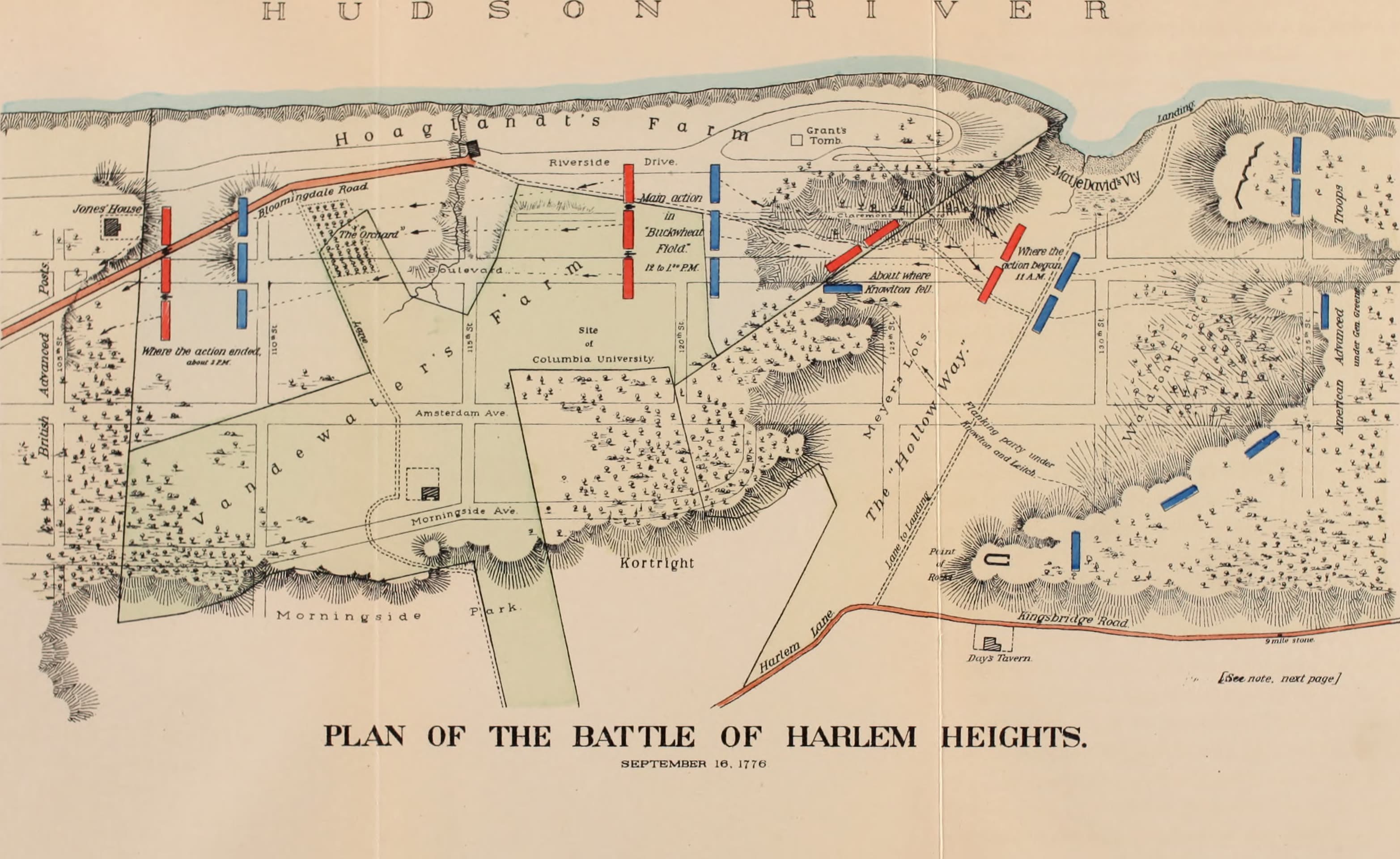
Before dawn on September 16, Washington sent Knowlton and roughly 120 of his rangers south across the terrain feature known as the Hollow Way to gather information on the British forces at Bloomingdale Heights.
They went south to the farmhouse of Nicholas Jones, where they were spotted by British pickets who fired their guns to alert the light infantry and 42nd Highlanders — the feared Black Watch — camped nearby. Knowlton and his men fired shots at the British and took cover behind a stone wall.
For more than half an hour the skirmish raged across farm properties before Knowlton, realizing the numerically superior British were about to turn his flank, ordered a retreat conducted "without confusion or loss."
What happened next became one of the battle's most infamous moments. As the rangers crossed back into the American lines and the pursuing British light infantry paused at the tree line to reorganize, the sound of their bugle calls struck Washington's Adjutant