
1727–1806
General Horatio Gates
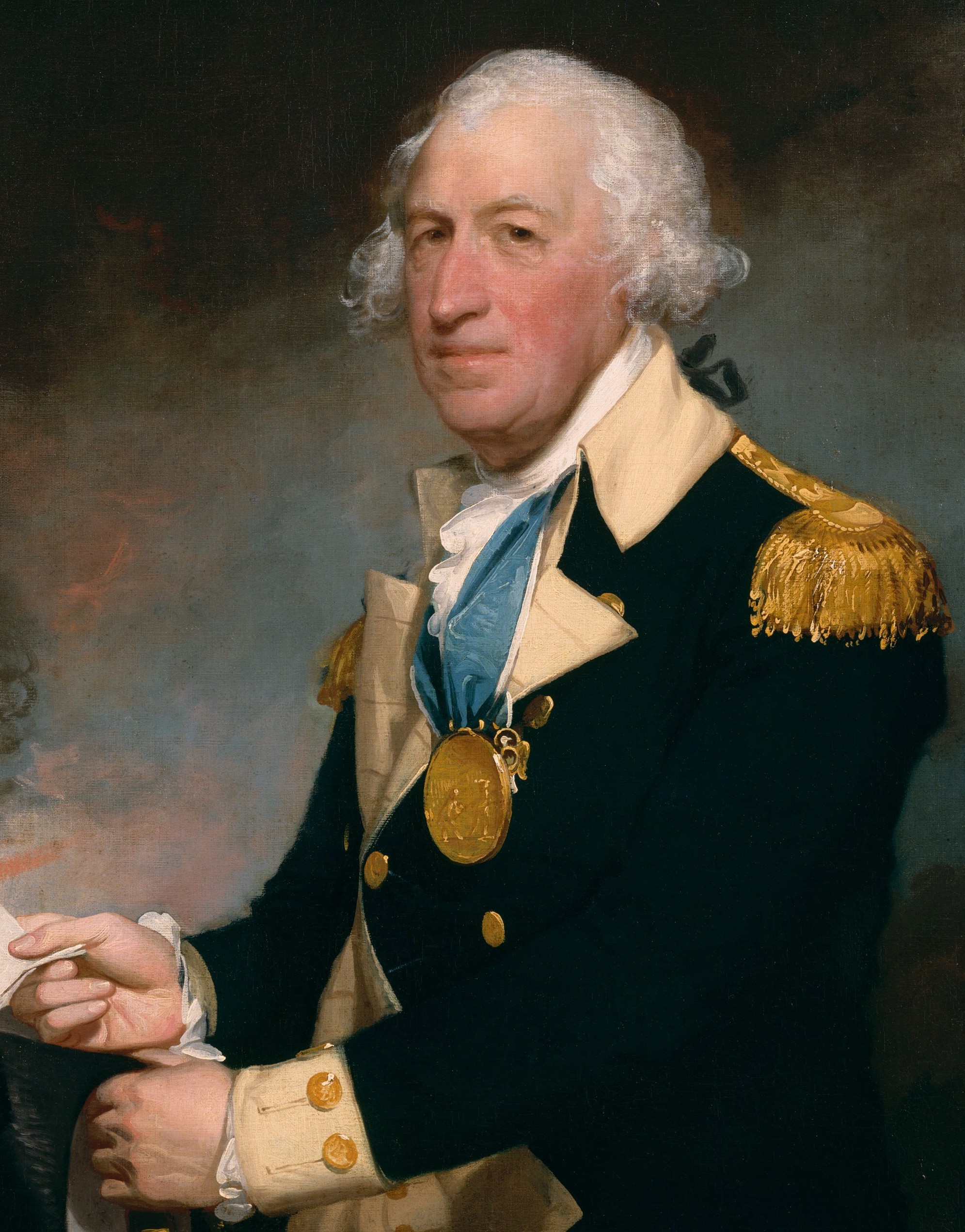
Gilbert Stuart, betw
Biography
General Horatio Gates (1727–1806)
Continental Army General, Victor at Saratoga, and Central Figure of the Newburgh Conspiracy
Born in Maldon, Essex, England, in 1727, the man who would become one of the most controversial generals of the American Revolution came from modest origins that shaped his lifelong ambition and sensitivity to matters of rank and recognition. Horatio Gates entered the British Army as a young man, serving during the War of the Austrian Succession and later in North America during the French and Indian War, where he fought alongside many future leaders of both the British and American causes. His military experience in the colonies gave him intimate knowledge of American terrain, logistics, and the complexities of frontier warfare. He was wounded during the disastrous Braddock expedition of 1755, an experience that left lasting impressions about the limits of conventional European tactics in the American wilderness. Unable to rise further in the rigidly class-conscious British officer corps — his lack of aristocratic connections proved an insurmountable barrier — Gates emigrated to Virginia in 1772, purchasing a plantation and establishing himself among the colonial gentry. This personal frustration with British hierarchies may well have predisposed him toward the revolutionary cause, and when tensions between the colonies and the Crown finally erupted into open conflict, Gates was unusually well positioned to offer both military expertise and ideological commitment to the new struggle.
When the Continental Congress began organizing an army in 1775, Gates's professional military background made him an invaluable asset in a force desperately short of trained officers. Congress appointed him adjutant general of the Continental Army with the rank of brigadier general in June 1775, a role that placed him at the administrative heart of the military effort during its most chaotic early months. In this capacity, Gates worked to impose order on the sprawling, undisciplined collection of militia and volunteers gathering around Boston, helping to establish the organizational frameworks — supply chains, muster rolls, disciplinary procedures — that would allow the Continental Army to function as something more than an armed mob. His British Army training proved essential in these early months, and his efforts earned him genuine respect among both officers and congressional delegates. Yet even at this early stage, Gates displayed the political maneuvering that would characterize his later career, cultivating relationships with influential members of Congress and positioning himself for independent command rather than remaining content in a supporting role. By 1776, he had secured command of the American forces retreating from the failed Canadian invasion, and his ambitions were clearly directed toward a major field command where he could demonstrate his strategic abilities and claim the glory that he believed his talents deserved.
The triumph that defined Gates's military career came at Saratoga in the autumn of 1777, a victory so consequential that it altered the entire trajectory of the Revolutionary War. Commanding the Northern Department of the Continental Army, Gates orchestrated the campaign that surrounded and ultimately forced the surrender of General John Burgoyne's entire British army — roughly 6,000 troops — on October 17, 1777. The strategic implications were enormous: the destruction of Burgoyne's force ended Britain's plan to sever New England from the rest of the colonies by controlling the Hudson River corridor, and more critically, it provided the dramatic proof of American military viability that persuaded France to enter the war as an open ally. The French alliance brought money, naval power, professional soldiers, and diplomatic legitimacy that proved indispensable to the ultimate American victory. Yet even at Saratoga, controversy followed Gates. His relationship with his most aggressive subordinate, Benedict Arnold, deteriorated badly during the campaign, and questions arose about how much of the tactical success belonged to Gates's overall strategy versus the initiative of field commanders who acted independently. Nevertheless, the victory was real, its consequences were transformative, and Gates emerged from the autumn of 1777 as the most celebrated American general besides Washington himself.
The years following Saratoga brought a devastating reversal that exposed the limits of Gates's abilities and judgment. His involvement in what became known as the Conway Cabal — a murky episode in the winter of 1777–1778 in which several officers and congressional delegates appeared to be maneuvering to replace Washington with Gates as commander in chief — damaged his reputation even though the full extent of his participation remains debated. Then came the catastrophe at Camden, South Carolina, on August 16, 1780, where Gates led an American army into a disastrous engagement against Lord Cornwallis. The Continental force was routed, Gates himself fled the battlefield on horseback, and his military reputation was effectively destroyed in a single afternoon. He was relieved of command and faced a congressional inquiry, though he was never formally censured. By the time the army gathered at its cantonment near Newburgh, New York, in the winter of 1782–1783, Gates occupied a peculiar position: still a major general, still respected by some officers for Saratoga, but widely distrusted by Washington's inner circle and carrying the accumulated weight of political miscalculations that had transformed him from the army's greatest hero into one of its most polarizing figures.
Gates's relationships with the other principal figures of the Revolution reveal much about the internal politics that constantly threatened to fracture the American cause. His relationship with George Washington was defined by rivalry, suspicion, and an asymmetry of character that ultimately determined their respective places in history. Where Washington cultivated a reputation for disinterested republican virtue — subordinating personal ambition to the collective cause — Gates repeatedly allowed his desire for recognition and advancement to compromise his political judgment. His association with Thomas Conway, the Irish-born French officer who openly criticized Washington's generalship, alienated powerful allies and branded Gates as a schemer willing to undermine the commander in chief during wartime. At Newburgh, Gates's connections to figures like Major John Armstrong Jr., who authored the inflammatory anonymous addresses circulating among the officers, placed him at the center of a crisis that tested whether the Continental Army would remain subordinate to civilian authority. Whether Gates actively organized the conspiracy or merely allowed himself to become its figurehead remains one of the enduring questions of the period. What is certain is that Washington's unexpected appearance at the officers' meeting on March 15, 1783, and his emotionally devastating address, rendered Gates once again a secondary figure in a drama that reaffirmed Washington's unmatched moral authority over the army and the nation.
The legacy of Horatio Gates presents students of the American Revolution with a figure far more instructive than simple heroes or villains. His story illuminates the fragility of the revolutionary enterprise — the reality that the American cause was sustained not by unanimous purpose but by fractious, ambitious, flawed individuals whose personal rivalries and political calculations constantly threatened to undermine the effort. Gates eventually freed the enslaved people held on his Virginia plantation and relocated to New York, where he lived quietly until his death on April 10, 1806, a figure largely forgotten by a republic that preferred cleaner narratives of its founding. Yet his contributions were genuine: without Saratoga, there would likely have been no French alliance, and without the French alliance, American independence might never have been achieved. That the same man who secured this indispensable victory also became entangled in efforts to displace Washington and may have helped organize a conspiracy that threatened civilian control of the military speaks to the complicated, often contradictory human realities that lay beneath the Revolution's idealized surface. Gates's career reminds us that the founding generation was not a collection of marble statues but a group of intensely human figures whose virtues and failures were often inseparable from one another.
WHY GENERAL HORATIO GATES MATTERS TO NEWBURGH
Horatio Gates's story is essential to understanding why the events at Newburgh in March 1783 represent one of the most dangerous moments in American history. As the senior officer who presided over the March 15 meeting at the Temple — and as the figure most widely suspected of organizing or encouraging the conspiracy behind it — Gates stands at the center of a crisis that tested whether military power would remain subordinate to democratic governance. Students and visitors to Newburgh can stand where officers gathered that day and consider what might have happened if Washington had not intervened, and what Gates's role reveals about the internal tensions that nearly destroyed the republic before it began. His story teaches that the Revolution was won not only on battlefields but in moments of institutional restraint.
TIMELINE
- 1727: Born in Maldon, Essex, England
- 1755: Wounded during the Braddock expedition in the French and Indian War
- 1772: Emigrates to Virginia and purchases a plantation
- 1775: Appointed adjutant general of the Continental Army by Congress
- 1777: Commands American forces at the Battles of Saratoga; secures surrender of General Burgoyne on October 17
- 1777–1778: Implicated in the Conway Cabal, an apparent effort to replace Washington as commander in chief
- 1780: Suffers catastrophic defeat at the Battle of Camden, South Carolina, on August 16; relieved of command
- 1783: Presides over the officers' meeting at the Temple in Newburgh on March 15, where Washington delivers his famous address
- 1790s: Frees the enslaved people on his Virginia estate and moves to New York
- 1806: Dies in New York on April 10
SOURCES
- Mintz, Max M. The Generals of Saratoga: John Burgoyne and Horatio Gates. Yale University Press, 1990.
- Kohn, Richard H. Eagle and Sword: The Federalists and the Creation of the Military Establishment in America, 1783–1802. Free Press, 1975.
- Nelson, Paul David. General Horatio Gates: A Biography. Louisiana State University Press, 1976.
- National Park Service. "Saratoga National Historical Park." https://www.nps.gov/sara/
- Golway, Terry. Washington's General: Nathanael Greene and the Triumph of the American Revolution. Henry Holt, 2005.