NY, USA
Kingston
The Revolutionary War history of Kingston.
Why Kingston Matters
Kingston, New York: The Crucible of a State and the Fire That Forged It
Few American towns can claim that they served as the birthplace of a state government and were reduced to ashes for exactly that reason, all within the span of a single extraordinary year. Kingston, New York, nestled along the western bank of the Hudson River in Ulster County, holds that rare and painful distinction. In 1777, while the great strategic contest for control of the Hudson Valley reached its climax, Kingston became the site where New York's first constitution was adopted, where its first governor was inaugurated, and where its first senate convened — only to be put to the torch by British forces determined to punish the town for its revolutionary audacity. The story of Kingston during the American Revolution is one of creation and destruction, of political courage tested by military violence, and of a community that rebuilt itself from ruin. It is also a story that illuminates, with unusual clarity, the fragile and contested nature of American self-governance at the very moment of its birth.
To understand why Kingston mattered in 1777, one must first understand the strategic geography of the war. The British grand strategy for that year centered on splitting the American colonies in two by seizing the Hudson River corridor. General John Burgoyne would drive south from Canada, while British forces in New York City would push northward, and a third column under Colonel Barry St. Leger would advance from the west through the Mohawk Valley. If all three converged, New England — the cradle of rebellion — would be severed from the mid-Atlantic and southern colonies. The Hudson Valley was therefore not merely a theater of war but the hinge upon which the entire conflict turned. Kingston, situated roughly midway between Albany and New York City, found itself at the center of this contest not by accident but by the logic of revolution and geography alike.
Even before the war's most dramatic year, Kingston had established itself as a hub of patriot activity. Its population, largely descended from the Dutch settlers who had founded the town as Wiltwyck in 1652, was overwhelmingly sympathetic to the American cause. The town's stone houses, sturdy Dutch Reformed church, and busy commercial life made it a natural gathering place for the committees and conventions that were, by 1776, effectively governing New York in defiance of British authority. When the Provincial Convention of New York — the extralegal body that had assumed governmental power after the collapse of royal authority — needed a safe location away from British-occupied New York City, Kingston was a logical choice. The Convention, which had been chased first to White Plains and then to Fishkill, finally convened in Kingston in February 1777. There, at the stone courthouse on Wall Street in what is now the Stockade District, its members undertook one of the most consequential acts of the entire revolution: the drafting of a new state constitution. Three men were instrumental in that work: John Jay, Robert R. Livingston, and Gouverneur Morris — all three affluent young men, ages 30, 29, and 24 respectively at the time of their appointments . John Jay is generally credited as being the primary author of the constitution.
The Convention formally met at the Ulster County Courthouse beginning on March 6, 1777, where the committee led by Jay, Livingston, and Morris presented their governing compact.
They presented this compact to the Convention on March 12th and, after due deliberation and discussion, the New York State Constitution was ratified by the members on April 20, 1777.
The constitution was adopted that Sunday evening with but one dissenting vote.
It was not submitted to the people for ratification, but became effective immediately upon its adoption by the convention.
The Constitution was read in public for the first time on the front steps of the Ulster County Courthouse two days later, on April 22, 1777. The document was a remarkable achievement of revolutionary statecraft. It limited the powers of the governor, established a two-house legislature, and balanced power among the three branches of state government.
The constitution required that voters own real property, but instituted the secret ballot at elections — an innovation that would echo in the design of the federal Constitution a decade later.
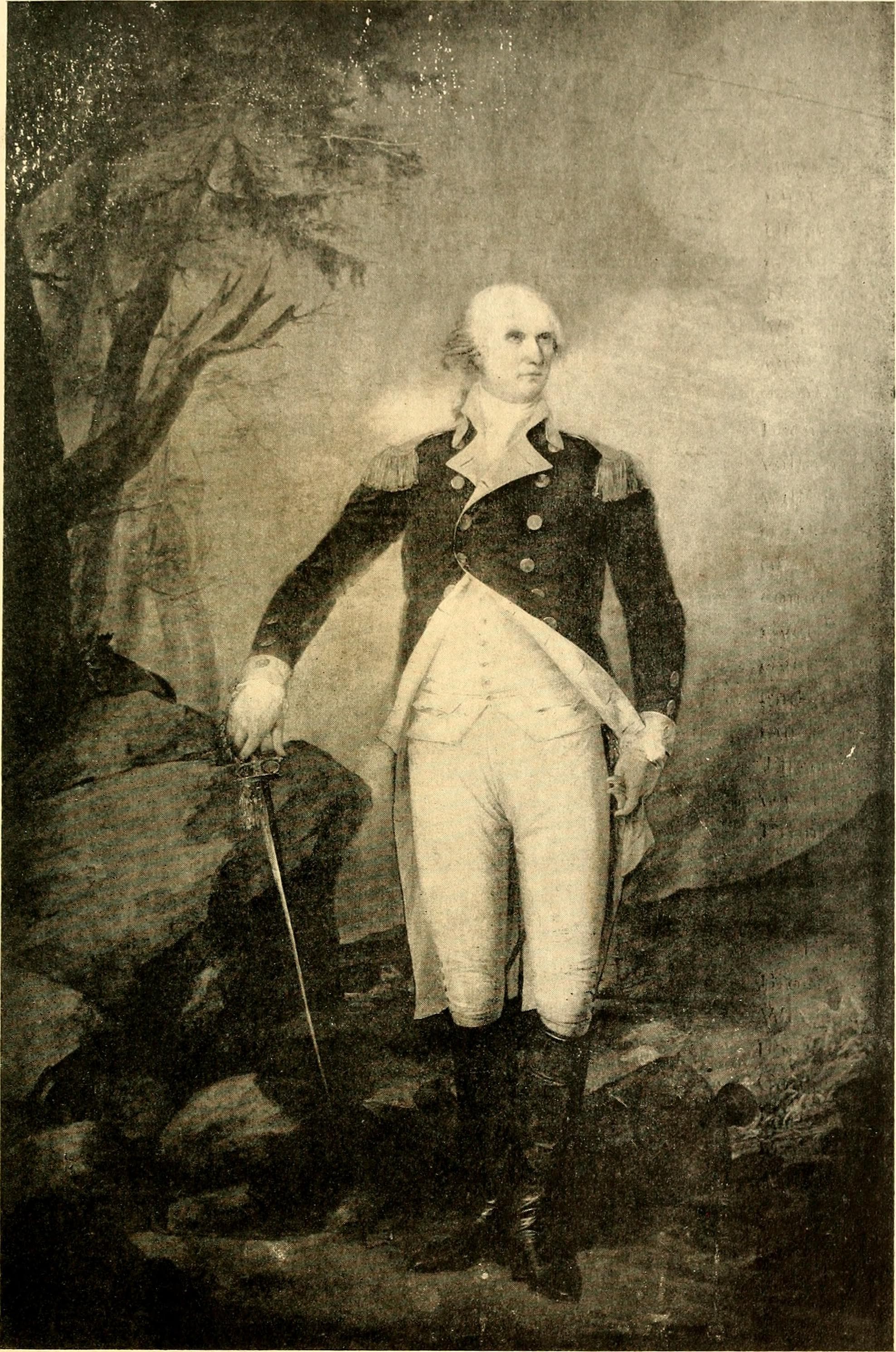
With the constitution ratified, Kingston became, in effect, the first capital of the State of New York. The first elections under the new framework were held in June 1777, and the results confirmed the revolutionary character of the community. George Clinton, a country lawyer and the son of a farmer, was sworn in as governor at Kingston on July 30.
Clinton had been elected to the Continental Congress but left for military duty before signing the Declaration of Independence;
in December 1775 the New York Provincial Congress had commissioned him brigadier general in the militia and called on him to defend the Highlands of the Hudson River from British attack.
He took the oath of office at the Ulster County Courthouse — the first official act of New York State.
John Jay was appointed the first chief justice of the New York State Supreme Court.
The 1st New York State Legislature, consisting of the New York State Senate and the New York State Assembly, met from September 9, 1777, first at Kingston. With no single building in Kingston large enough to house the new government, each branch rented separate spaces.
The state's fledgling judiciary met in the courthouse, the assembly convened at Bogardus Tavern, and seventeen of the twenty-four appointed representatives in the senate assembled at Van Gaasbeek's house — the home of local merchant Abraham Van Gaasbeek, which is today referred to as Senate House. That stone dwelling, built in 1676 in the Dutch Colonial style, became the unlikely seat of New York's new upper chamber. In September 1777, Chief Justice Jay also found an opportunity to publicly explain the significance of the new constitutional order: he assembled the new state's first grand jury at Kingston to investigate counterfeiting, and on September 7, before turning to the issue at hand, he took the opportunity to explain why the Revolution had occurred, what was at stake, and the principles of the new state constitution.
But even as these acts of political creation were under way, the military danger was closing in. "We are hellishly frightened," Gouverneur Morris wrote to a friend on October 8, 1777, as reports reached Kingston of British forces advancing up the Hudson. As part of Britain's 1777 three-pronged invasion of New York, British General John Vaughan sailed toward Kingston with 1,600 soldiers and a fleet of 30 ships to create a diversion as General John Burgoyne fought American forces in Saratoga.
On the morning of October 16, 1777, the British fleet arrived at the mouth of Rondout Creek and began a land attack on the Village of Kingston. The Ulster militia, consisting of 150 troops, was unable to defend against the British force of 1,200 troops.
The British found the village largely vacated, with the exception of a few stragglers and the militia forces defending it;
the residents of Kingston had fled southward through Hurley the evening before.
Calling Kingston "a nursery for almost every Villain in the Country," Vaughan burned the city and destroyed more than 400 houses, barns, and mills on October 16, 1777.
After roughly one month of meeting, the Senate, along with the rest of the new government, had been forced to flee from advancing British troops just prior to the burning.