SC, USA
Camden
The Revolutionary War history of Camden.
Why Camden Matters
Camden, South Carolina: The Crucible of American Defeat and Resilience
Long before the first musket was fired in anger along its sandy roads, Camden, South Carolina, occupied a place of strategic importance in the colonial backcountry. Founded in 1732 as Fredericksburg Township and later renamed for Charles Pratt, the first Earl of Camden and a champion of colonial rights in Parliament, the town sat at the head of navigation on the Wateree River and served as a vital crossroads linking Charleston to the interior. Originally known also as Pine Tree Hill, the settlement had attracted Quakers and Scots-Irish emigrants from Virginia by the 1750s , and by 1780 it was the oldest and largest town in the Carolina backcountry . That year, it became the linchpin of British strategy in the South — and the site of one of the most devastating American defeats of the entire Revolutionary War. What happened at Camden in the scorching summer of 1780 exposed the fragility of the patriot cause at its lowest ebb, cost the life of one of the Continental Army's most gallant officers, destroyed the reputation of one of its most celebrated generals, and ultimately set the stage for the strategic recalibration that would turn the tide of the war in the Southern theater.
To understand Camden's significance, one must first grasp the dire circumstances facing the American cause in the spring and summer of 1780. Charleston had fallen to British forces under General Sir Henry Clinton on May 12, 1780, in the worst American surrender of the war — over five thousand Continental soldiers captured in a single stroke. With Charleston secured, the British established a network of fortified outposts across South Carolina to pacify the countryside, and Camden became the most important of these inland garrisons. Viewed east to west, the British fortified a chain of posts stretching from Georgetown and Cheraw through Camden to Ninety Six and Augusta, and Camden sat at its strategic center. Lord Charles Cornwallis, the aggressive and capable lieutenant general left in command of British forces in the South after Clinton returned to New York, recognized Camden's value as the hub from which British power could radiate into the Carolina interior. British subjugation of the rebel colonies in the South depended on control of outposts and supply depots, and the largest was at Camden, about 115 miles inland from the coast. The town's position — located on a crossroads of the routes to Charleston and Savannah — allowed control over supply lines, communication routes, and the fertile agricultural land that sustained military operations.
When Cornwallis marched his 2,500 troops into Camden in June 1780, his army encountered no opposition. The British promptly confiscated any property of value, including the opulent Georgian mansion of local merchant and patriot Joseph Kershaw, his mills, and his store. Cornwallis's men fortified the grounds with a stockade wall and five redoubts, and constructed barracks and a hospital, with Kershaw's house serving as headquarters for both Cornwallis and Lieutenant Colonel Francis Lord Rawdon, the British commandant at Camden. Kershaw himself, a native of Yorkshire, England, who had arrived in the Carolina backcountry around 1758 and had become the town's principal founder and leading citizen, paid dearly for his patriotism. He had served as a colonel in the South Carolina militia, led his regiment at the Battle of Stono Ferry in June 1779, and worked as a legislator to win the support of interior settlers and Catawba Indians for the patriot cause. After the fall of Camden, the British captured Kershaw, cast him into prison in irons, and exiled him — first to British Honduras and then to Bermuda, where he lived for fifteen months. Even from captivity, Kershaw managed to mortgage his Carolina estates to Bermuda merchants for £9,000 to purchase desperately needed clothing and military supplies for American forces, though the shipment was intercepted and confiscated by the British. He was eventually released in a prisoner exchange and returned to a war-ravaged Camden, spending the remainder of his life attempting to recover from the ruinous financial losses he had sustained in the cause of liberty. Kershaw County, formed in 1791, was named in his honor.
During British occupation, Camden consisted of two city blocks of per
The stage was now set for the confrontation that would become one of the darkest days in American military history. In July 1780, Major General Horatio Gates — the celebrated "Hero of Saratoga" — arrived to take command of the shattered Southern Department, bringing with him Major General Johann de Kalb's 1,400 Continental regulars, who had been marching south since April. Gates, brimming with the confidence of his triumph over Burgoyne three years earlier, ordered an immediate advance on Camden against the advice of his own officers, choosing a direct route through barren, swampy terrain that offered little in the way of food or friendly inhabitants. His hungry soldiers were reduced to eating unripe corn and peaches, and by mid-August many were desperately weakened by dysentery. By August 13, the army had reached Rugeley's Mill, about twelve miles north of Camden, where it was reinforced by North Carolina and Virginia militia, swelling Gates's force to roughly 3,700 men — though he grandly and inaccurately believed he commanded more than 7,000.
On the evening of August 15, Gates fed his men a hasty meal of cornmeal laced with molasses — a substitute for the customary rum ration — that acted as a purgative on their already ravaged digestive systems. Despite this, he ordered a night march toward Camden, commencing at 10:00 PM. By fateful coincidence, Cornwallis — who had rushed to Camden from Charleston with reinforcements upon learning of Gates's approach, arriving on August 13 and increasing the British garrison to approximately 2,240 men — ordered his own night march at the same hour, with Banastre Tarleton's dragoons in the lead. The two columns collided in the darkness around 2:00 AM on August 16. After a brief, confused skirmish, both sides halted and formed lines, waiting for daylight.
At dawn, the disaster unfolded with terrible swiftness. The battlefield was hemmed in on both sides by dense swamps, offering no room for maneuver. Gates deployed his forces in a conventional manner that proved catastrophic: he placed his weakest troops — the inexperienced Virginia and North Carolina militia — on his left flank, directly opposite the veteran British regulars under Lieutenant Colonel James Webster. His strongest units, the Maryland and Delaware Continentals under Baron de Kalb, anchored the right. When Webster's redcoats unleashed a volley, huzzahed, and charged with bayonets, the Virginia militia broke and ran without firing a shot, and the North Carolina militia quickly followed. The entire American left wing collapsed in minutes.
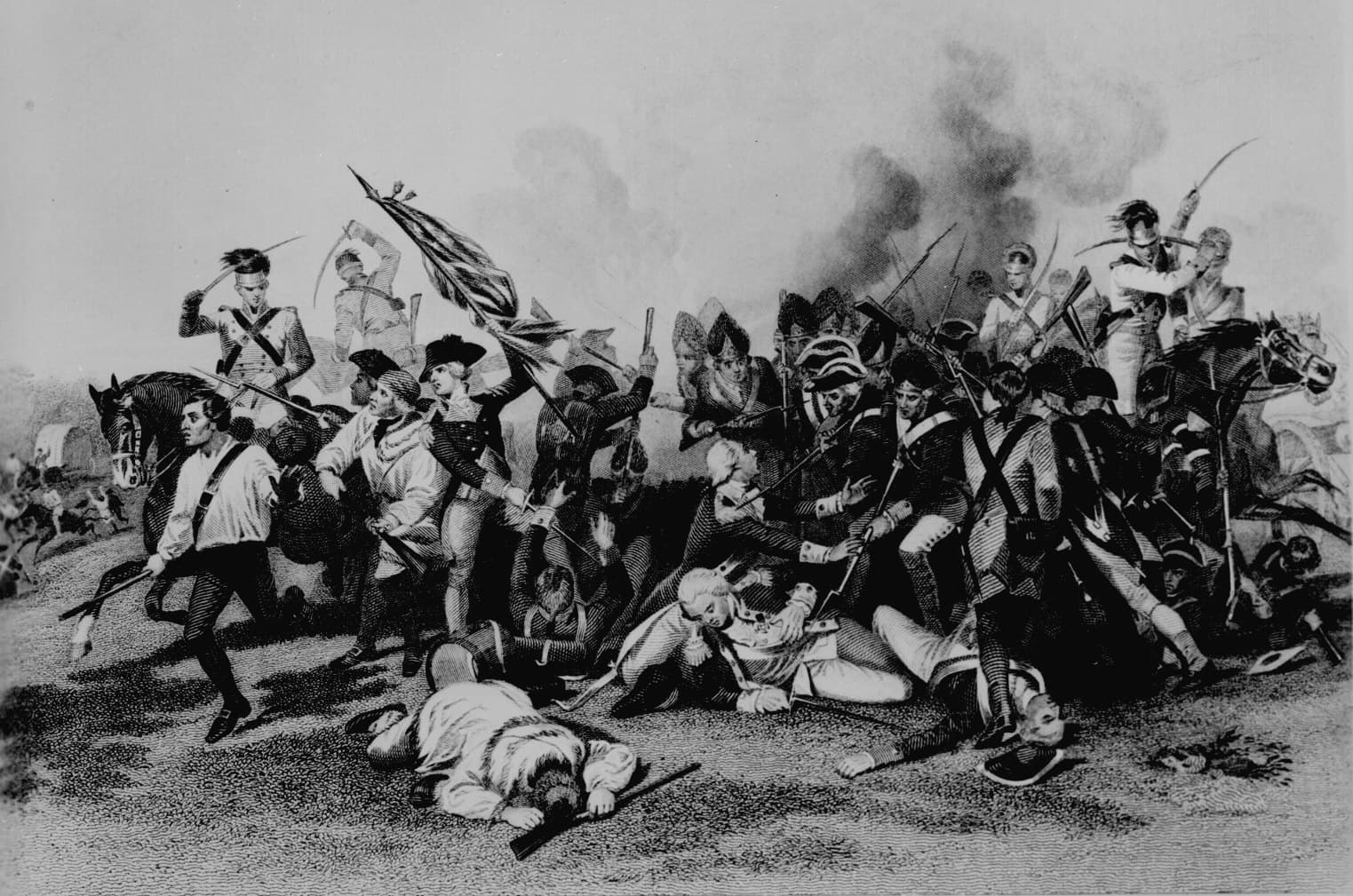
On the right, Baron de Kalb and his Continentals fought on with desperate valor, pressing the Loyalist troops opposite them. But with the left and center gone, Webster wheeled his regulars and struck the exposed Continental flank. Surrounded and overwhelmed, de Kalb — the German-born veteran who had come to America with the Marquis de Lafayette in 1777 and who had devoted his life to the profession of arms across two continents — refused to retreat, rallying his men in the thickest of the fighting until he was shot from his horse and fell, pierced by eleven musket ball and bayonet wounds. The 59-year-old general was captured by the British and carried from the field. Cornwallis, upon seeing the mortally wounded de Kalb, reportedly expressed his respect, saying he was "sorry to see you so badly wounded," and ordered his own surgeons to tend to the fallen general's injuries. De Kalb lingered for three agonizing days before dying on August 19, 1780, in Camden. He was initially buried in a cemetery near the battlefield; in March 1825, his remains were exhumed and reinterred with honors at the Bethesda Presbyterian Churchyard in Camden, where they rest today.
As for Gates, the "Hero of Saratoga" fled the battlefield on the fastest horse available, reaching Charlotte, North Carolina — some sixty miles distant — by nightfall. It was a flight that would live in infamy. The toll was staggering: approximately 900 Americans killed or wounded and over 1,000 captured, along with the loss of cannon, muskets, and the army's entire baggage train. British losses were comparatively light — roughly 68 killed, 245 wounded, and 11 missing. The Battle of Camden was, by many measures, the worst defeat ever inflicted on an American army during the Revolution. On December 2, 1780, Congress removed Gates from command, and General George Washington replaced him with the far more capable Major General Nathanael Greene — a decision that would prove pivotal to the outcome of the war.
But Camden's role in the Revolution did not end with the catastrophe of August 16. The town remained a fortified British garrison under Rawdon's command from June 1780 until May 1781, and during those eleven brutal months it served not only as a supply depot and military headquarters but also as a prison camp. Captured Americans were confined in Camden throughout the British occupation; a steady stream of prisoners arrived from the constant fighting in the backcountry. Among the prisoners held