
MA, USA
Arlington
The Revolutionary War history of Arlington.
Why Arlington Matters
The Bloodiest Ground: Arlington and the Battle of Menotomy, April 19, 1775
On the evening of April 19, 1775, as the last shots of a long and terrible day echoed through the villages northwest of Boston, the people of Menotomy — the small Massachusetts farming community now known as Arlington — began to take account of what had happened in their streets, yards, and houses. What they found was staggering. More men had been killed in Menotomy that day than at Lexington Green, the North Bridge in Concord, or any other single point along the running battle between British regulars and colonial militia. Of the approximately 73 British regulars and 49 provincials killed on April 19, 1775, 40 regulars and 25 provincials lost their lives along the 1.5-mile stretch between the Foot of the Rocks and Cooper's Tavern. This was not the symbolic "shot heard round the world." This was the Revolution's first sustained, house-to-house, close-quarters killing ground, and it happened in a town that most Americans today have never heard of. A few weeks after the battle, Hannah Fayerweather Winthrop wrote to her friend Mercy Otis Warren describing the carnage she had observed, recalling "passing thro the Bloody field at Menotomy which was strewd with the mangled Bodies."
It was here in Menotomy that the first British soldiers were captured.
The village's very name testified to its deep roots. Menotomy was a crossroads village of about 400 farmers, millers, tavern keepers, and their families, its name deriving from the Indigenous term for "flowing water," a reference to the town's Mill Brook.
The Concord road through Menotomy followed the course of Mill Brook for about three miles, its swift flow powered by a fall of 150 feet in that short distance. European colonists had established nine separate mill sites along the brook, beginning with Captain George Cooke's grist mill in 1638, and they built and improved roads from these mills to their markets in all the neighboring towns, with taverns serving the travelers to and from the mills.
Thus in colonial times Menotomy was an important hub for local farmers. Political leaders knew it as a relatively safe place to exchange information and plan for the coming of war. And spies, especially those serving the Royal Governor, General Thomas Gage, scouted its highways for avenues to enforce royal authority. The roads radiating out in many directions would prove vital for messengers riding out, and militia companies coming in to defend the colony.
The town was incorporated in 1807 as West Cambridge, losing its original Indian name, and renamed as Arlington sixty years later.
To understand why the fighting in Menotomy was so ferocious, one must first understand the geography and timing of the day. By early afternoon on April 19, the British expedition under Lieutenant Colonel Francis Smith — sent from Boston the night before to seize colonial military stores in Concord — was in full retreat along the Bay Road (roughly today's Massachusetts Avenue). The regulars had exchanged fire at Lexington at dawn, faced organized resistance at Concord's North Bridge, and were now being harassed by an ever-growing swarm of militia companies converging from towns across eastern Massachusetts. Smith's column was on the verge of disintegration when, near the eastern edge of Lexington, it was met by a relief force of roughly 1,400 men under Brigadier General Hugh Percy, 2nd Duke of Northumberland. Percy had marched out of Boston that morning with fresh troops, artillery, and ammunition. His arrival saved Smith's battered force from annihilation, but the combined British column — now numbering close to 1,800 — still had to fight its way back to the safety of Boston, and their route ran directly through Menotomy.
Percy's relief column had already passed through Menotomy that morning on its way to meet Smith, and the passage had been tense but largely bloodless. Lord Percy himself reported the houses of Menotomy "deserted" at midday as he marched through with over 1,000 of His Majesty's soldiers — but appearances were deceiving. By the time the merged British force returned in the late afternoon, however, the situation had changed completely. Militia companies from dozens of towns — Menotomy, Cambridge, Brookline, Roxbury, Danvers, Lynn, Needham, Dedham, Salem, Beverly, and others — had been pouring in since the retreating British troops reached the Foot of the Rocks in Menotomy around 4 p.m. Thirteen towns had sent militia, now stationed along both sides of the road the Redcoats would take back to Boston.
Typical of the new arrivals was the minuteman company from Danvers, led by 26-year-old Lieutenant Gideon Foster. He and his men had reached Menotomy — a 16-mile march — in just four hours. Foster positioned his men along a stone wall flanking a hillside orchard, alongside minutemen from Lynn, Needham, and Dedham.
The Eve of Battle: The Committee of Safety and the Black Horse Tavern
Menotomy's role in the events of April 19 had actually begun the day before. On April 18, the Provincial Committees of Safety and of Supplies met in Menotomy in Ethan Wetherby's tavern known as the Black Horse.
They had been meeting jointly throughout the winter for a shared purpose: to procure and distribute weapons, munitions, and rations for the defense of the Massachusetts Bay Colony from General Gage's 4,000-strong garrison.
The Committees felt safe enough in Menotomy that when they adjourned on the 18th, they voted to meet again in the same place the next day. Three Committeemen from Marblehead — Jeremiah Lee, Elbridge Gerry, and Azor Orne — decided to lodge overnight at the Black Horse, their homes being almost 20 miles distant. Gerry, a future signer of the Declaration of Independence and Vice President of the United States, would very nearly be captured that night. That sense of safety was shattered sometime after 3:00 AM. The expeditionary force of 800 Royal troops under the command of Lt. Col. Francis Smith came marching up the Concord road, and a detachment pounded on the tavern door and demanded entry. The Marbleheaders eluded capture by leaping out the back windows, dressed only in their nightclothes, and hiding themselves in a chilly field of corn stubble for an hour.
Lee contracted a fever from the exposure that led to his death on May 10, 1775 — one of the Revolution's earliest and least-remembered casualties.
Richard Devens, another committee member who lived in Charlestown, had returned home in time to inform Paul Revere that he had seen a British Patrol on the road to Concord. Gerry also sent a message to John Hancock, who was staying in Lexington with Samuel Adams, warning him of the British movements.
Indeed, Paul Revere had beaten Smith to Menotomy by three hours, stopping there to warn the minute men's Captain Benjamin Locke on his ride to Lexington.
The Old Men of Menotomy and the Supply Wagon Ambush
Before the main column's return, Menotomy witnessed another remarkable action. Earlier that day, a convoy of provisions and supplies, protected by a detachment of British Regulars, arrived behind the main force heading toward Lexington and faced difficulties crossing the Brighton Bridge. Before their arrival, the Committee of Safety had removed the planks, and the combination of heavy wagons and repairs to the bridge caused the convoy to become separated from the main force, rendering
Themes
Citizen Soldiers
Militia from multiple towns converged here to fight
Liberty and Freedom
The deadliest fighting of the day that started the war
Women of the Revolution
Civilian women caught in the violence; Mother Batherick legend
Preservation and Memory
Jason Russell House preserved with bullet holes intact
Enslaved and Free Black Voices
Black militiamen participated in the fighting
Military Innovation
Guerrilla tactics and close-quarters combat
Propaganda and Communication
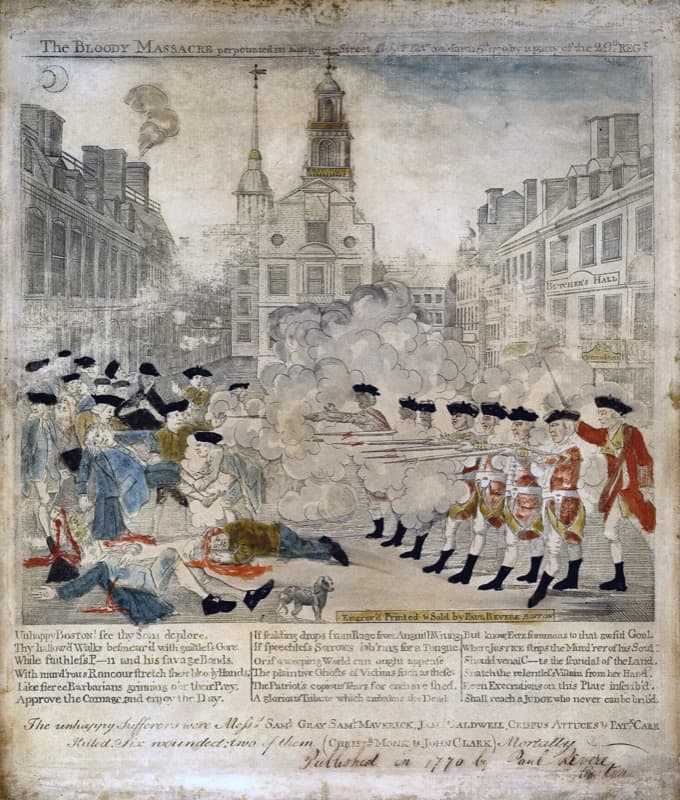
Menotomy casualties used in propaganda about British brutality
Loyalists and a Divided Society
Community torn apart; some fled, others fought
Historical Routes
Menotomy Battlefield Walk
Stop 1 of 3
Menotomy Battlefield Walk
Stop 2 of 3
Menotomy Battlefield Walk
Stop 3 of 3
Battle Road: Arlington Section
Stop 2 of 3